

Abbreviations
AI – Artificial Intelligence
CM – Critical Mineral
CRM – Critical Raw Material
CRMA – Critical Raw Materials Act
EC – Electrical Component
EOL – End of Life
GM – Growth Mineral
PCB – Printed Circuit Board
PGM – Platinum Group Metal
PM – Permanent Magnet
REE – Rare Earth Element
RIR – Recycling Input Rate
R&D – Research and Development
SRM – Strategic Raw Material
WEEE – Waste Electrical and Electronic Equipment
Introduction
The CIRCUIT4EU Project has identified nine Critical Raw Materials (CRMs) to target: Antimony (Sb), Boron (B), Copper (Cu), Cobalt (Co), Nickel (Ni), Platinum Group Metals (PGMs), Light and Heavy Rare Earth Elements (LREEs, HREEs) and Tantalum (Ta). Except for Antimony and Tantalum, each of these materials are additionally classed as Strategic Raw Materials (SRMs), which are materials prioritised for EU resilience.
Critical Raw Materials (as defined by the Critical Raw Materials Act (CRMA)) are materials with high economic importance and a significant supply risk. SRMs are a subset of the CRMs selected for their importance in the green transition through renewable energy technologies, defence, and digital technologies. The lists were first established in 2011 and are regularly reviewed. The most recent CRM and SRM lists were published in 2023, expanding the set of CRMs to include thirty-four materials.
The Nine Chosen CRMs – How important are they?
The nine chosen CRMs together make up 11.6% of CRMs and SRMs found in WEEE. Copper makes up almost a quarter of this due to its wide range of applications and use in most electronic products, however, many components that require critical materials utilise them in low quantities and for highly specified uses. Therefore, while not making up a bulk percentage of CRM usage by weight, materials such as Rare Earth Elements can be just as important to functionality as ones such as Copper.
CIRCUIT4EU has a specific range of products and components where research will occur, these being: printed circuit boards (PCBs), permanent magnets (PMs), electrical components (ECs), housed within e-Scooters, dishwashers, Wi-Fi boxes, and laptops. These components and appliances each rely on one or more of the nine focus CRMs to function, with some PCBs containing eight out of the nine. The CRMs chosen for the project have a combination of high value, high importance, and increasingly volatile supply chains.
Get to know the focus CRMs!
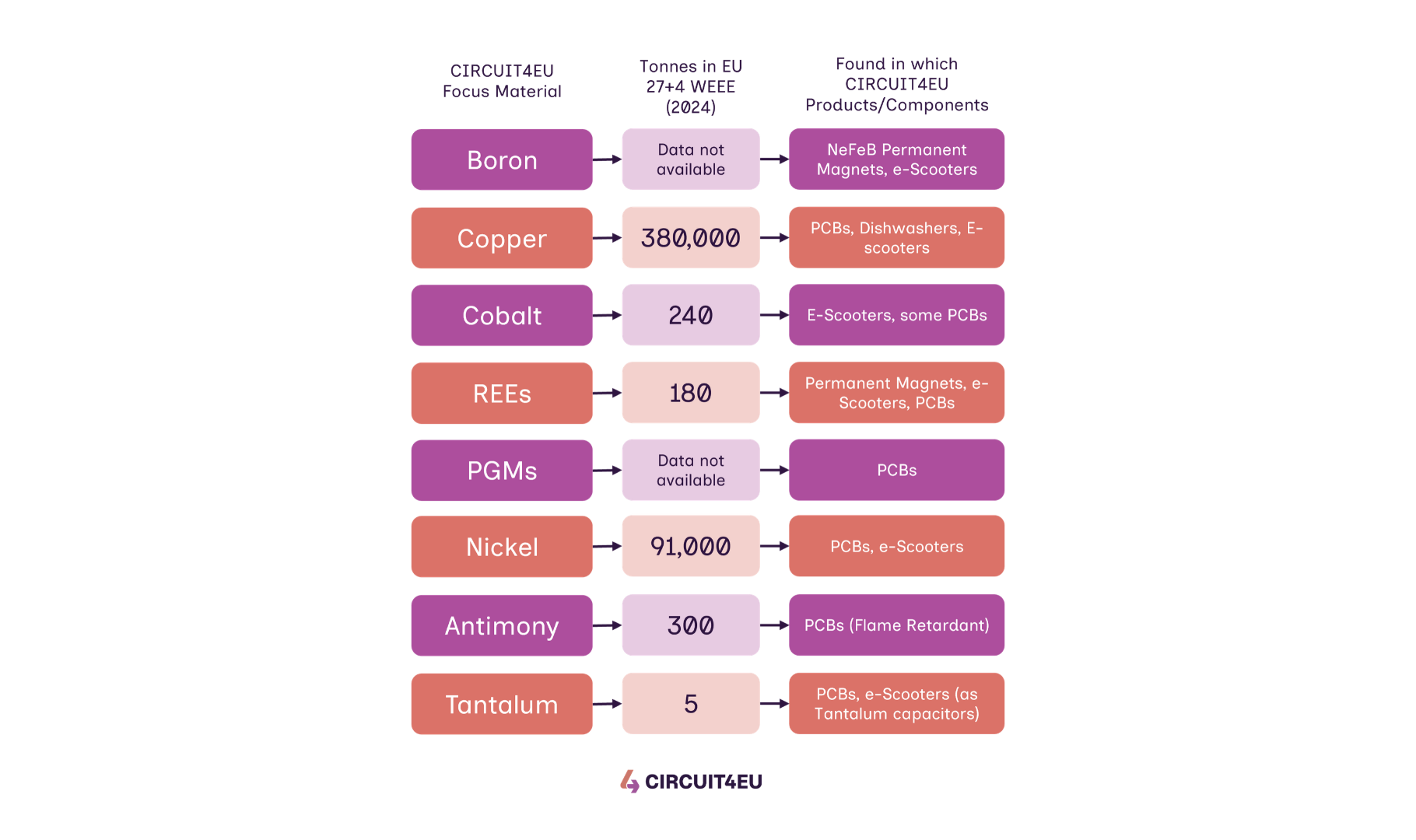
Nine CRMs information, Lucy Wilkins using data from the Urban Mine Platform
Antimony (Sb)
Antimony is a metal element primarily found in the sulphide mineral form of Stibnite (Sb2S3). Within WEEE, Antimony is found in casings and plastics due to its use as a flame retardant. Antimony oxides are also used to enable electroceramic technologies.
In 2024, 1,700 tonnes of Antimony within WEEE were collected. Recycling and reuse of this Antimony remains underutilised, however, Horizon project, PLAST2bCLEANED recently pioneered antimony recovery techniques, obtaining high purity antimony oxide from plastic polymers.
Boron (B)
Boron is a chemical element with semiconductor properties. This means that at high temperatures, it acts like a metal conductor, whereas, at low temperatures, it also acts as an insulator.
Boron is an essential element in the most common composition of permanent magnet, NdFeB. Within WEEE, Boron also has a wider use in the form of borosilicate glass, often used for phone screens and other displays.
Copper (Cu)
Copper is an extremely ductile metal, with extremely good electrical and heat conducting properties. Copper is the most common cable and wire material due to these properties and makes up a major proportion of WEEE by weight, with 170,000tonnes collected in 2024.
Copper demand is set to outgrow production as early as 2033, so increasing recovery and reuse is becoming ever more important.
Cobalt (Co)
Cobalt is a ferromagnetic metal that is widely dispersed in small quantities globally. A key concern with cobalt is the EU’s heavy reliance on imports, which stands at 86%. Most of this imported cobalt comes from the Democratic Republic of Congo, where conflict mining and forced labour are widespread. Recycling and reusing cobalt therefore does more than strengthen the EU’s material resilience. It also reduces dependence on mining practices that cause serious human harm.
The main use of Cobalt is in batteries, but it is also present in electronic components like sensors and in some permanent magnets it is also an important element.
Nickel (Ni)
Nickel is a ferromagnetic metal which is extraordinarily resistant to oxidation and corrosion. 530,000 tonnes of Nickel was collected within WEEE in 2024. Nickel plating is an integral part of PCBs, one of CIRCUIT4EU’s focus product.
Platinum Group Metals (PGMs)
Platinum group metals are a group of six elements with similar properties. Platinum group metals are both highly valuable and strategically important, with wide use as catalysts. Palladium, one of the key PGMs, is present in printed circuit boards and can be recovered for reuse.
Light and Heavy Rare Earth Elements (LREEs, HREEs)
Rare Earth Elements consist of 17 elements with similar properties. REE are not only notoriously hard to extract economically but 85-90% of the world’s REE refining capacity is located in China. China is equally responsible for over half of all Rare Earth Element mining globally and its recently imposed export controls in retaliation to US-China tariffs, created an export bottleneck for Rare Earths.
They are mainly used in Permanent Magnets but are also found within PCBs due to their semiconducting properties. However, due to the above highlighted issues, reuse and recycling is becoming increasingly important for these difficult-to-obtain materials.
Tantalum (Ta)
Tantalum is a relatively rare, dense metal with extremely good resistance to acids. Tantalum is most commonly used in capacitors, one of the most widespread components in electronics. These capacitors are often attached to PCBs and other electrical circuits before dismantling, which makes them a key component within CIRCUIT4EU. What is more, currently, over 40% of the Tantalum found within WEEE either ends up in landfill or is lost during processing.
Current Recycling Rates
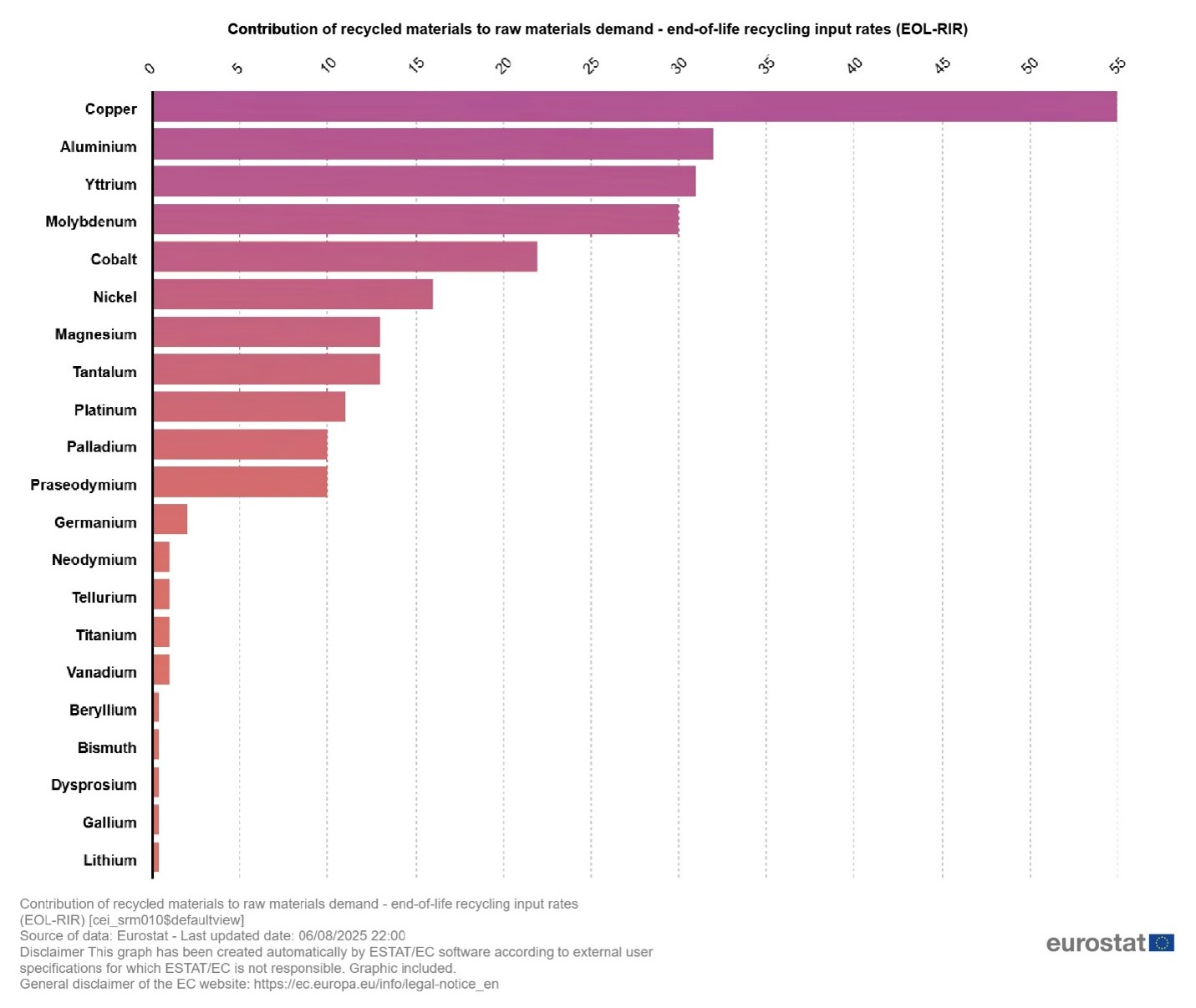
Recycling rates vary significantly between the 34 elements that make up the full CRM list. Looking at the complete list, Copper has a high 55% end of life recycling input rate (EOL RIR), whereas seven other CRMs have an EOL RIR of only 1 to 5%, and ten CRMs are not recycled at all within the EU.
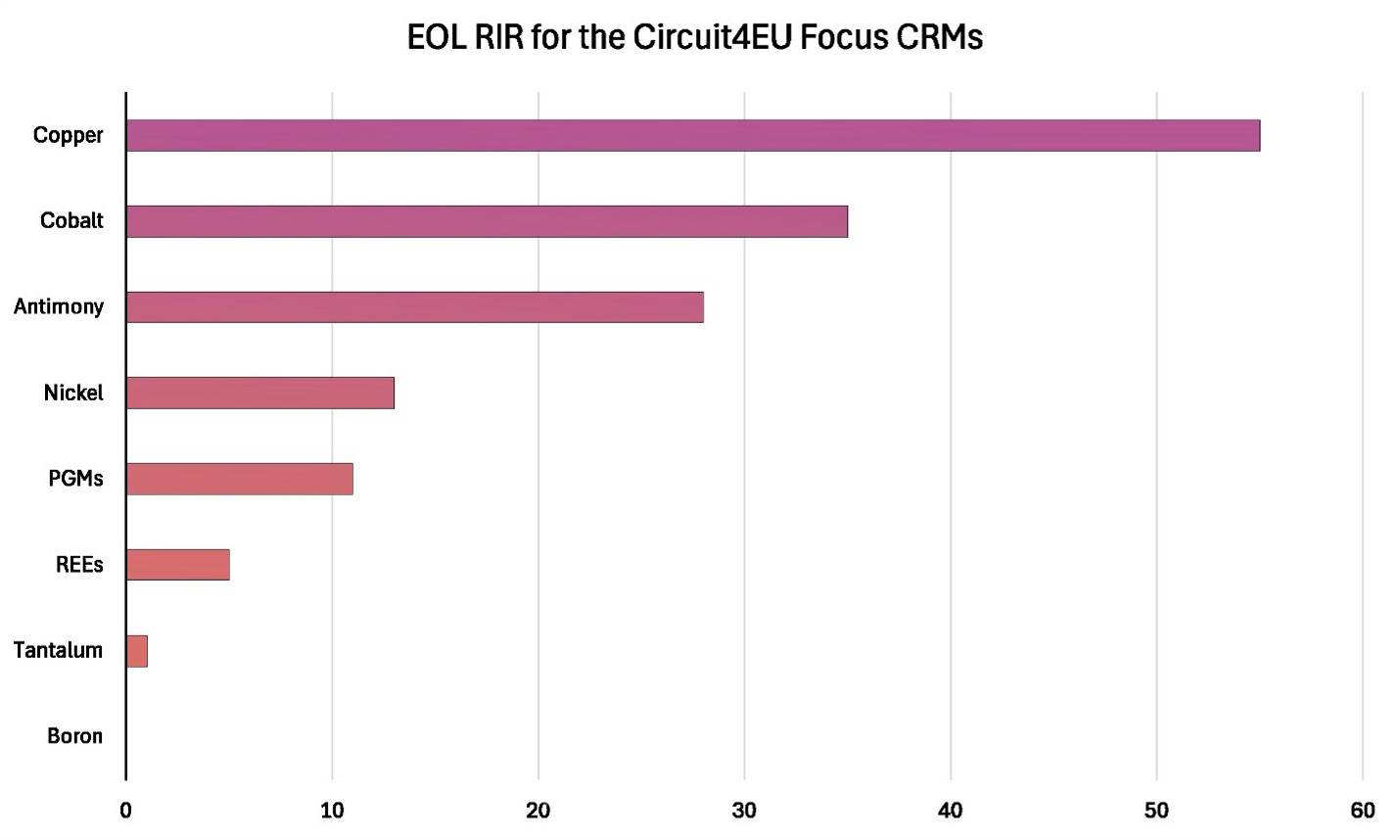
The end-of-life recycling input rates of the nine CIRCUIT4EU focus CRMs range from 55% for copper to 0% for boron. This range shows that the project covers a broad set of the CRMs found in its target products, including materials with well-established recycling pathways, rather than just those that have lower recycling rates.
Recovery Targets in Europe
Alongside revealing the newest CRM and SRM lists, the European Critical Raw Materials Act (CRMA) established a set of goals and targets for 2030 in relation to CRMs. One of these targets was to meet 20% of CRM demand through domestic recycling.
Targets for recycling of CRMs vary across the world, with individual EU countries being able to set their own goals within the CRMA framework, alongside countries such as the UK having their own individual set of regulations. The UK’s Critical Mineral Intelligence Centre (CMIC) set an ambitious target of having 25% of the UK’s CM (Critical Mineral) demand met by recycling by 2035.
The EU’s circular material use rate rose from 10.7% in 2010 to 12.2% in 2024. This puts it more than halfway to the target, but it means the rate grew by only 1.5 % over 14 years. This statistic also accounts for all materials, rather than for CRMs alone, meaning that the number includes much more commonly recycled materials such as plastics and cardboard, suggesting that the true value for CRM circular material use rate is likely much lower.
CIRCUIT4EU aims to help increase the circular material use rate for Critical Raw Materials, alongside other R&D projects, by enabling selective management of CRMs and SRMs within PCBs, PMs, and electrical components to further their recovery. And while the 2030 target may prove difficult to achieve at current recycling rates, any increase is beneficial, especially as demands for CRMs grow at unprecedented rates due to a growing consumer market and technological developments such as the rise of Artificial Intelligence (AI).
Conclusion
The recovery of CRMs is becoming increasingly important as demands grow and new geopolitical tensions arise. WEEE is one of the main sectors where CRMs are lost: in the UK alone, 350,000 kilograms of CRMs and precious materials, worth over £148 million, are found in WEEE each year – yet less than half of this is being recovered. If more appliances and devices found within WEEE were separated for reuse, dismantled and had components extracted, the recovery rate for CRMs from WEEE could be significantly increased.
The nine CIRCUIT4EU focus CRMs are essential to a wide range of everyday products, well beyond those within the project’s scope. Recovering more of them could therefore deliver significant economic and environmental benefits.CIRCUIT4EU has chosen CRMs which are not only relevant to the immediate project but have key roles in a sustainable future and the wider WEEE industry.